

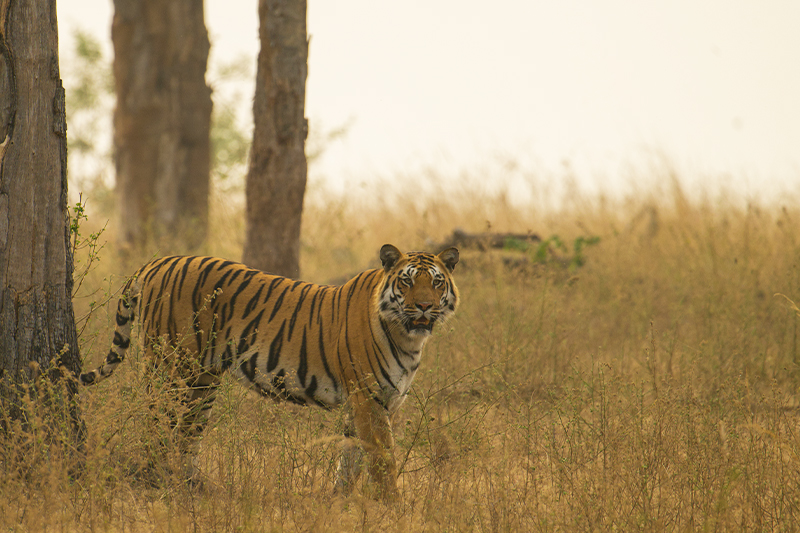
Where The Forest Decides Its Kings
Pench is not a forest of stillness. It is a forest of motion — of silent patrols at dawn, of scent marks etched into dust and bark, of roars that echo through valleys long after the tiger has vanished into tall grass.
For those who truly understand Pench, the tiger is not just an animal to be seen. He is a force that reshapes the forest itself.
Every dominant male tiger in Pench writes a chapter — not with words, but with territory, lineage, and survival. Today, four such males define the power dynamics of this legendary landscape. Their stories overlap in rivalry and inheritance, in fading reigns and rising ambitions.
This is not merely a list of tigers.
This is a living chronicle of Pench.
In Pench, dominance is never permanent — only earned for a while.
The Anatomy of Power in Pench
Before we meet the kings, one must understand what dominance truly means in a tiger
reserve like Pench.
A dominant male controls:
- Access to breeding females
- Prime hunting grounds
- Water sources and travel corridors
- The survival fate of cubs not sired by him
When a new male takes over, the forest resets. Genetics change. Cubs disperse or
perish. Tigresses adapt, migrate, or re-establish territories. This cycle —
brutal yet necessary — keeps Pench strong.

L Mark – The Emperor Who Ruled by Experience
L Mark’s story is deeply entwined with Pench’s modern tiger history.
After the legendary Rayakasha male receded from dominance, it was L Mark who filled the vacuum — not through dramatic battles, but through persistence, strength, and timing. He took over vast, high-value territories rich in prey, shade, and water — areas that every tigress prefers for raising cubs.
For years, L Mark was the undisputed monarch.
His movements were predictable yet powerful. He patrolled methodically, rarely engaging in unnecessary confrontation. Tigresses within his territory bred successfully, producing cubs that would later:
- Establish sub-territories
- Disperse toward buffer forests
- Contribute to Pench’s expanding tiger population
Many of today’s young and upcoming tigers carry L Mark’s bloodline, even if his physical dominance is now waning.
But time is undefeated.
Age has slowed his reflexes. His territory, once vast, has begun to fragment. Younger males test boundaries he once guarded effortlessly.
“A great king does not fall — he gradually makes room for the future.”
L Mark’s legacy is not measured by territory alone, but by generations.

Kumbha – The Unseen Guardian of Karmajari
If L Mark ruled visibly, Kumbha ruled quietly.
Occupying the Karmajari side and adjoining landscapes, Kumbha controls an ecologically crucial stretch of Pench — a zone that connects core forest to buffer and dispersal routes. This makes him one of the most strategically important males in the reserve.
Kumbha’s style of dominance is understated:
- Minimal aggressive displays
- Strong territorial fidelity
- Calculated avoidance of unnecessary fights
Yet he is no less powerful.
Multiple tigresses overlap his range, and his mating success ensures strong genetic flow toward buffer areas. Cubs born in his territory are often the ones that later move out, strengthening Pench’s larger tiger landscape beyond tourism zones.
“True dominance does not seek attention — it commands space.”
For wildlife photographers and seasoned naturalists, Kumbha sightings often feel intimate — a tiger confident enough not to perform.

Swastik – The Young Prince Who Became a Storm
Swastik represents inevitability.
Strong, young, and increasingly assertive, Swastik has emerged as the primary challenger to L Mark’s long-held dominance. His rise has not been impulsive. Instead, it reflects a deep understanding of tiger politics.
Swastik began by:
- Testing peripheral areas
- Repeatedly patrolling contested zones
- Increasing scent-marking frequency
- Avoiding direct confrontation until advantage was clear
Slowly, decisively, he began capturing major portions of L Mark’s territory.
With territory comes mating access — and with mating access comes a shift in Pench’s genetic future. Tigresses that once bred under L Mark now accept Swastik’s dominance. Cubs born in this transition phase symbolize a new era.
“Every forest remembers the moment youth took over.”
Swastik’s confidence is visible in his stride. His story is still unfolding — but his imprint on Pench is already undeniable.
X Mark – The Question Forest Is Asking
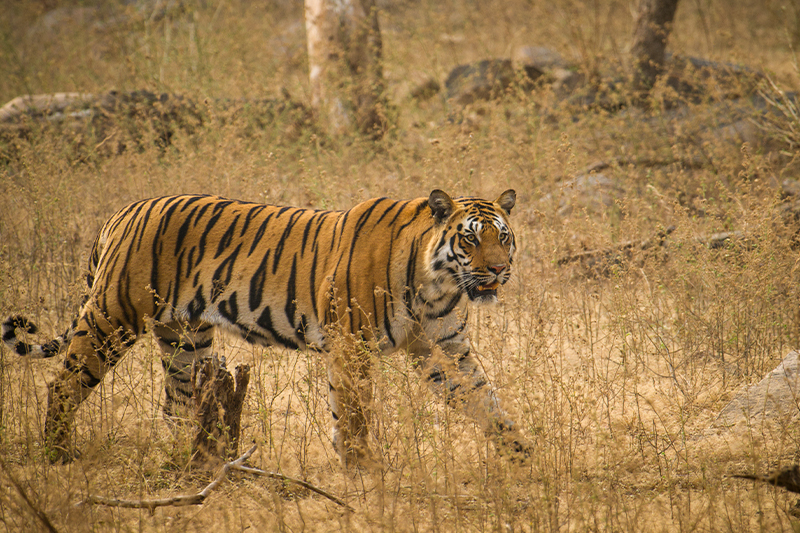
X Mark is not yet a king — but he is a claimant.
A young male navigating a forest crowded with powerful rivals, X Mark has begun
acquiring parts of L Mark’s former territory, exploiting the gaps created by
shifting dominance.
What makes X Mark fascinating is his intelligence:
- Strategic avoidance of major confrontations
- Quick establishment of scent marks
- Adaptive movement across lesser-used corridors
Whether he becomes a future dominant male or disperses to carve his own kingdom
elsewhere remains uncertain. But Pench thrives on such uncertainty.
“Every legend begins as a question.”
X Mark’s journey reminds us that dominance is not always immediate — sometimes it
is quietly prepared.
The Females Behind the Kings
A forest ruled by males is shaped by females.
Each dominant male’s success depends on resident tigresses — their choices, adaptability, and resilience. As territories change hands, tigresses:
- Shift core areas
- Relocate cubs
- Accept new males to ensure lineage survival
Through these females, bloodlines flow and futures are secured.
“The strength of Pench lies as much in its mothers as in its kings.”
The Circle of Power and Survival
Territorial change in Pench is not chaos — it is balance.
Old kings fade.
Young challengers rise.
Bloodlines refresh.
The forest remains strong.
For travellers, every sighting gains depth when seen through this lens. A scarred male crossing the track is not just a tiger — he is history walking. A confident young male scent-marking is not posing — he is announcing the future.
At JungleTrail, this understanding defines how we design safaris. We do not chase sightings — we follow stories.

Safari Tips: Where to Spot Pench’s Dominant Males
Understanding Zones Over Names
Tiger territories shift frequently. Rather than focusing only on names, focus on recent movement patterns, fresh markings, and naturalist insights.
Likely Areas & Strategies
L Mark
- Older, established core routes
- Morning safaris offer better chances due to habitual movement
- Look for well-used paths and traditional marking trees
Kumbla
- Karmajhiri Gate and adjoining buffer areas
- Late afternoon safaris near water bodies
- Often seen resting calmly rather than actively patrolling
Swastik
- Transitional zones between former L Mark territories
- Cooler hours (early morning & late evening)
- Frequent marking and movement behaviour visible
X Mark
- Peripheral tracks and recently vacated ranges
- Sightings unpredictable but rewarding
- Requires patience and experienced tracking
Safari Pro Tip: Ask your guide about territorial changes from the previous week — Pench’s tiger map evolves faster than any printed zone chart.
Why Pench is a Coffee-Table Forest
- Multiple dominant males within close proximity
- Visible generational shifts within short spans
- Strong photographic opportunities of behaviour, not just presence
- A living example of natural selection in action
“Pench does not guarantee a tiger — it guarantees a story.”
A Final Word
The kings of Pench do not pose for cameras.
They walk their territories, unseen and unbothered, shaping the forest with every step.
To witness them is privilege.
To understand them is transformation.
And once you do — Pench is never just another safari again.